



Microchip Technology PIC32MZ W1 System-on-Chip (SoCs)
Microchip Technology PIC32MZ W1 System-on-Chips (SoCs) are high-performance, Wi-Fi MCU SoCs with a MIPS M-Class core, robust connectivity, and 2MB memory for software development. Along with a powerful core, PIC32MZ2051-W1 provides industry-leading connectivity supporting 2.4GHz 802.11 b/g/n radio modes. These devices feature a rich set of peripherals, including Ethernet, USB, ADC, CVD touch buttons, and CAN.
Features
- Wireless interfaces
- PHY
- IEEE® 802.11 b/g/n WLAN link
- Single spatial stream of 20MHz channel bandwidth
- External FEM support for Power Amplifier (PA), Low Noise Amplifier (LNA), and Transmitter/Receiver (TX/RX) switch
- 2.4GHz (2400MHz to 2483.5MHz) ISM band
- MAC
- Infrastructure BSS STA mode
- Soft-AP mode functionality
- Active and passive scanning
- Transmit power control support over temperature and voltage
- Security
- WPA3 personal (SAE and PMF-802.11w)
- WPA2 personal with options for WPA compatibility and PMF
- WEP
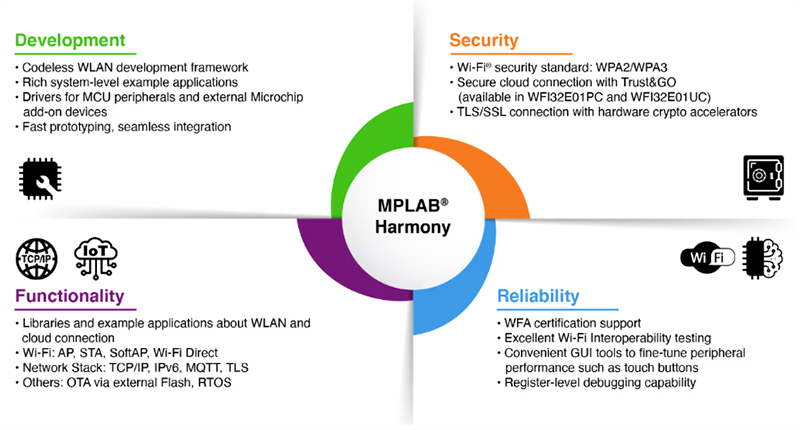
- Harmony Networking
- Out-of-box support for MPLAB® Harmony v3 TCP/IP stack
- TLS v1.2 with symmetric/asymmetric crypto acceleration
- Wi-Fi power save modes
- Wireless sleep mode (WSM)
- Wireless deep sleep mode (WDS)
- Wi-Fi time-stamping support
- PHY
- 200MHz, MIPS32® M-Class microprocessor core
- 16KB I-Cache, 16KB D-Cache
- Fixed mapping translation (FMT) based MMU for optimum embedded OS execution
- microMIPS™ mode for up to 35% smaller code size
- DSP-enhanced core
- 4x 64-bit accumulators
- Single-cycle MAC, saturating and fractional math
- Code-efficient (C and assembly) architecture
- On-chip Flash and SRAM
- PIC32MZ1025W104
- 1MB Flash program memory
- 64KB boot program Flash
- 256KB SRAM (program and data)
- 64KB data buffer (DBF)
- Dedicated buffer for peripherals
- PIC32MZ2051W104
- 2MB Flash program memory
- 128KB boot program Flash
- 512KB SRAM (program and data)
- 128KB data buffer (DBF)
- PIC32MZ1025W104
- Power management and system recovery
- Low-power modes (dream, sleep, deep sleep, and extreme deep sleep)
- 8KB context SRAM for context storage under low power modes
- Deep sleep mode
- 32x semaphore registers (32-bit wide) for context storage
- 1.9µA (typical) current consumption
- PIC32MZ W1 SoC utilizes a 32-bit semaphore register for context storage with the following current consumption values in the extreme deep sleep mode
- 0.71µA (typical) for PIC32MZ1025W104132
- 1.06µA (typical) for PIC32MZ2051W104132
- Integrated power-on reset (POR), brown-out reset (BOR), zero-power BOR (ZPBOR), and programmable low voltage detect (PLVD)
- Secondary oscillator and fail-safe clock
- Fast power-up and brown-out recovery
- Security
- Hardware accelerated security modes (with built-in DMA support)
- Crypto engine with true random number generator (TRNG) for data encryption/decryption and authentication (AES, 3DES, SHA, MD5, and HMAC)
- AES modes
- Electronic codebook (ECB)
- Cipher block chaining (CBC)
- Counter mode (CTR)
- Cipher feedback mode (CFB)
- Output feedback mode (OFB)
- Galois/counter mode (GCM)
- Hardware accelerated public key cryptography with support for:
- 16-DSP multipliers configuration
- 256-bit ECC/ECDH/ECDSA/Curve25519
- 256-bit Ed25519
- 512-bit ECC/ECDH/ECDSA generation
- Clock management
- 40MHz primary oscillator (POSC)
- 32.768kHz secondary oscillator (SOSC)
- Power-up timer (PWRT) and oscillator start-up timer (OST)
- Fail-safe clock monitor (FSCM)
- On-chip clock sources
- 8MHz fast RC (FRC) oscillator
- 32.768kHz low-power RC (LPRC) oscillator
- Programmable PLLs and oscillator clock sources
- Independent watchdog timer (WDT), deadman timer (DMT), and independent deep sleep watchdog timer
- Fast wake-up and start-up
- Support for precise reference clocks to external devices
- Direct memory access (DMA)
- 8x channels with automatic data size detection
- Programmable 32-bit cyclic redundancy check (CRC)
- Advanced analog 12-bit ADC module
- 2x MSPS with 2x sample and hold (S&H) circuits (1x dedicated and 1x shared)
- Up to 20x analog input channels
- Sleep and idle mode operations
- Multiple trigger sources
- 2x digital comparators and 2x digital filters
- Supports self-capacitance touch interface with a maximum of 18x touch buttons and 1x driven shield
- Communication interfaces
- Up to 2x CAN modules (CAN and CAN-FD) with 2.0B active with DeviceNet™ addressing support
- Up to 3x UART modules (speeds up to 10Mbps), supports RS-232, RS-485, LIN 2.1, and IrDA protocols
- 1x Ethernet MAC module (10/100 Mbps) with RMII interface and dedicated DMA
- IEEE 1588 precision time protocol (PTP)
- Time synchronization support between Wi-Fi and Ethernet
- Up to 2x SPI (4-wire) modules with speeds up to 40MHz
- SQI configurable as an additional SPI module (60MHz)
- 1x full-speed USB 2.0 OTG interface with dedicated DMA
- 2x I2C (up to 1M baud) with SMBus support
- Timers/output compare/input capture
- 7x 16-bit or up to 3x 32-bit timers/counters
- 4x output compare (OC) modules
- 4x input capture (IC) modules
- Low-power precision real-time clock and calendar (RTCC)
- Input/output
- High current source/sink (up to 25mA) on all I/O pins
- Configurable open-drain, pull-up, pull-down, and slew rate controls
- External interrupts on all I/O pins
- Peripheral pin select (PPS) to enable function remap
- Up to 62x GPIO pins
- Peripheral trigger generator (PTG) with 8-bit user command for scheduling complex sequences
- Class B safety library support, IEC 60730
- Debugger development support
- In-circuit and in-application programming
- 4-wire MIPS® enhanced JTAG interface
- Unlimited software: 8x instruction and 4x data complex hardware breakpoints
- IEEE 1149.2-compatible (JTAG) boundary scan
- iFlowtrace functionality support: off-chip buffering of iFlowTrace messages
- Software and tools support
- C/C++ compiler with native DSP/fractional
- MPLAB® harmony integrated software framework
- TCP/IP, USB, graphics, and mTouch™ middleware
- MFi and Android™
- RTOS kernels: Express Logic ThreadX, FreeRTOS™, OPENRTOS®, Micriµm® µC/OS™, and SEGGER embOS®
- Supports over-the-air (OTA) and over-the-host (OTH) firmware update modes
- Dual row 132-pin DQFN package, 10mm x 10mm x 0.9mm
- 2.97V to 3.63V operating voltage range
- DC to 200MHz operating frequency range
- -40°C to +85°C operating temperature range
Software and Support
Block Diagram

Related Products

Microchip Technology WFI32E02UC High Pin Count (HPC) Wi-Fi® MCU Module
Offers 60x GPIO pins and is specially designed for industrial Internet of Things (IoT) applications.

Microchip Technology WFI32E02 High Pin Count (HPC) Curiosity Board
Enables the evaluation of the PIC32MZ1025W104 System-on-Chip (SoC) and the WFI32E02 Module.

Microchip Technology PIC32 WFI32 2.0 Curiosity Board
Evaluates the PIC32MZ2051W104132 System-on-Chip (SoC) and WFI32E03 Wi-Fi® module.

Microchip Technology WFI32E04UE Wi-Fi® MCU Module
High-performance solution designed for industrial applications.
Applications
- Industrial automation and control systems
- Smart home devices
- IoT-enabled sensors and equipment
- Medical devices
- Security and surveillance systems
- Robotics
- Remote monitoring and telemetry
- Wireless gateways and access points
- Consumer electronics
- Energy management and smart grid systems
- Building automation systems
Published: 2024-05-07
| Updated: 2025-03-13