MIKROE-6137

Mikroe
932-MIKROE-6137
MIKROE-6137

Mfr.:

Description:
Data Conversion IC Development Tools DAC 18 Click

Lifecycle:
New Product:
New from this manufacturer.

In Stock: 5

Stock:
5 Can Dispatch Immediately
Factory Lead Time:
4 Weeks Estimated factory production time for quantities greater than shown.
Minimum: 1   Multiples: 1
Unit Price:
€-.--
Ext. Price:
€-.--
Est. Tariff:

Pricing (EUR)

Qty. Unit Price
Ext. Price
€14.62 €14.62

Product Attribute Attribute Value Select Attribute
Mikroe
Product Category: Data Conversion IC Development Tools
RoHS:  
Add-On Boards
Compact Add-On Board
DAC539G2-Q1
3.3 V, 5 V
Brand: Mikroe
Description/Function: 10-bit Smart DAC
For Use With: Ideal for Automotive and Industrial
Interface Type: GPIO, I2C
Product Type: Data Conversion IC Development Tools
Subcategory: Development Tools
Products found:
To show similar products, select at least one checkbox
Select at least one checkbox above to show similar products in this category.
Attributes selected: 0

TARIC:
8473302000
CAHTS:
8543700000
USHTS:
8543709860
JPHTS:
854370000
ECCN:
EAR99

Mixed Signal Click Boards

Mikroe Mixed Signal Click Boards are used for mixed-signal solutions for various applications. Click Boards are based around the mikroBUS™ interface standard and easily add incredible system capabilities. The devices are ideal for any application requiring mixed-signal solutions like analog-to-digital converters. 

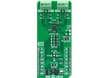
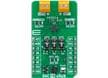
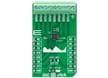
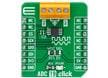
DAC 18 Click

Mikroe DAC 18 Click is a compact add-on board that converts general-purpose input to PWM signals, featuring the Texas Instruments 10-bit DAC539G2-Q1 smart DAC. The Mikroe DAC 18 Click provides two output channels. OUT1 for digital-to-analog conversion and OUT0 for voltage-to-PWM conversion with triangle or sawtooth waveforms. The board includes an operational mode selection pin for I2C programming or standalone operation, plus nonvolatile memory to store register settings. Ideal for automotive lighting and industrial applications, DAC 18 Click is compatible with the mikroBUS™ socket and supports the mikroSDK libraries for flexible evaluation. Its unique ClickID feature allows the host system to detect it automatically.